The Grants (1894-1917)
Harry Grant was the original owner who engaged Longley to build the house. Harry arrived in Caterham in 1893, initially renting Upwood House, slightly further up Tupwood Lane. It is likely that he chose Caterham because of his friendships with and connections to many other local businessmen who worked in the City of London. Harry was a partner at Knill and Grant a company of fruit brokers and warehouse keepers, one of the oldest of its kind in the City (founded c.1750). Its offices were at Monument Buildings, Pudding Lane, London, and it was responsible for some of the first imports of fruit from Australia. Harry’s partner was John Knill, who went on to become Sir John Knill, Lord Mayor of London in 1909. John’s father was Stuart Knill, also Lord Mayor of London (1892–3). Two other notable Caterham friends were Oliver Jones Trinder, who started his career with Harry’s father and went on to become Harry’s next-door neighbour at Cedar Grange (now North Downs Hospital) in 1897, and William Garland Soper who had been Master of the Worshipful Company of fruitiers and hence head of the guild to which Harry was affiliated.
The land for Twyford was acquired in 1894 from John Thomas Morton a successful industrialist who owned and occupied Cedar Grange. His northern land boundary was where Grange Road now lies. At the time that Harry was building Twyford, Morton was in the process of building five houses on Grange Road. This group of buildings was called Cedar Grange Estate, the architect being Frederick Elliff, the local Estates Office manager. Prior to this development Grange Road was just a footpath leading to some chalk pits. When Morton died in 1897 he left nearly £800,000 in his will (equivalent to £8 million today), including all the houses on Grange Road which were rented out. Interestingly, his factory workers, J. T. Morton Tinsmiths, established Millwall Football Club in 1885.
Harry Grant was born in Hackney in 1860. He was married to Florence Mary Fox who was born in 1868 in Stoke Newington and was the daughter of Charles James Fox, a linen merchant and landowner. Twyford initially consisted of seven acres, six of which were leased from Morton. Living at the house when first built were Harry, Florence, two sons (Lester and Noel) and three servants (two parlour maids and a cook). Living at Twyford Lodge was a groom, a gardener, and the gardener’s wife. Unfortunately, Harry and Florence’s first son Geoffrey died before his first birthday while they were living in their previous house, also called Twyford, in Birdhurst Rise, South Croydon.
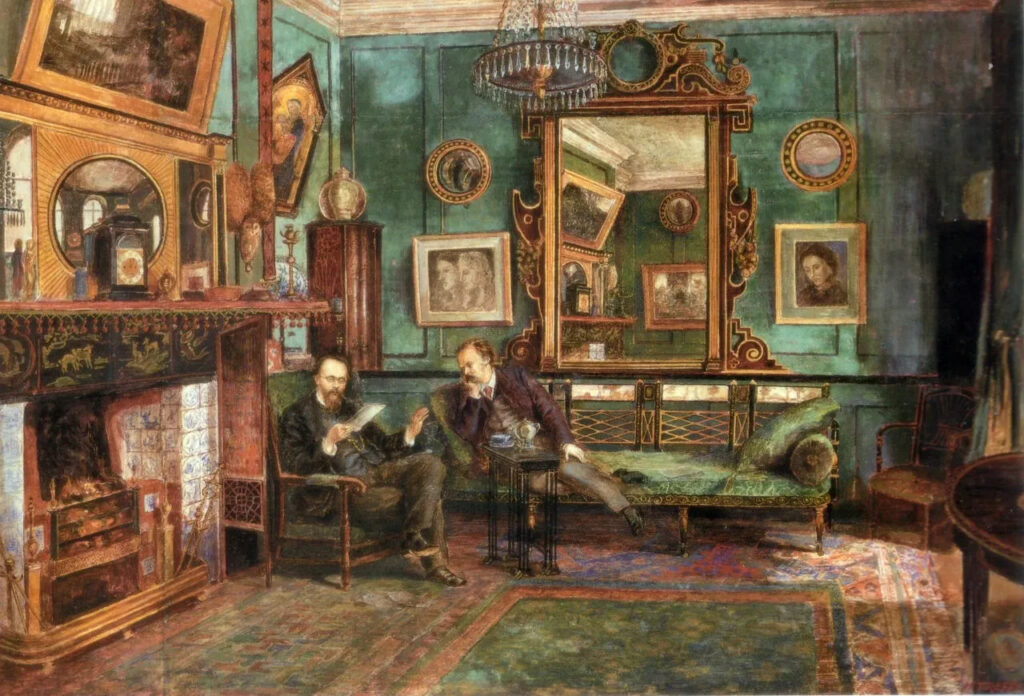
Harry and Florence were keen collectors of art, and Harry was also a keen amateur artist. Harry was very active in the local church (St John’s) and wrote several articles for the local newspapers concerning Free Trade. He was reported to be quite a robust character (as would have been expected of a London merchant). According to the London Daily News, 22 November 1906, Harry was sued for using excessive force while ejecting another fruit merchant from his auction room and was subsequently fined £80. Harry died on 5 January 1916 at the age of 55, leaving £12,886 in his estate (well over £1 million today). On 8 January 1916 The Weekly County Press & Post reported that ‘he had won the esteem of a large circle of friends … and had been an invalid for a considerable time.’ His local church, St John’s, reported in the church magazine: ‘he was a constant worshipper, we have lost another friend by the death of Mr. Harry Grant after a residence in our midst of more than a quarter of a century. Mr. Grant’s was an attractive character, quiet, gentle, unassuming. We shall remember him, as a worthy Christian gentleman, who by a blameless life gained our affection and esteem.’ The story of Harry and Florence’s idyllic country life in the Surrey Hills unfortunately had a sad ending. Their youngest son Noel enlisted in WW1, serving in 156 Brigade Royal Field Artillery, and was killed in action in France, 25 May 1917 (aged just 24), in the attack on the Hindenburg Line during the Battle of Arras. Noel had been the best man at Harry Lester’s wedding the year before. Shortly afterwards, Florence died on 20 December 1917 at the age of just 61, probably from a broken heart following the death of her beloved husband and youngest son. Sadly, following Florence’s death, all the contents of Twyford were put up for auction and anything that was not screwed down was sold. (Surrey Mirror 1918 image)
Harry and Florence’s eldest son, Lester Grant, went on to have a full life. Born on 9 April 1886 in Croydon, he was educated at Malvern College and had quite an extensive army career. During WW1 he served as a 2nd lieutenant in the Royal Garrison Artillery and then went on to serve in the army as a captain and adjutant. He travelled widely with the army, visiting America, Japan, China, Canada, the West Indies and South Africa between 1929 and 1939 and was vice-president of the Burma Society. In WW2 he again served in the Royal Artillery and APC Isle of Man (1941–43). Lester was quite artistic, a keen bird watcher, and he corresponded with many influential people, including Mark Twain, who wrote at least one letter to Twyford. Lester went on to be the director of theatres in Brighton.
Lester married Lilma Georgina Edith Browne (a local Caterham girl born in 1894) in Caterham on 11 September 1915 at St Mary’s church. The wedding party retired to The Beeches afterwards and was widely reported in the newspapers. It was a large wedding with over 300 guests. After their marriage, Lester and Lilma moved to Greenaway (Delmore) in Grange Road, which backed on to the side of Twyford. Lester and Lilma had a busy life travelling widely around the world, and there are various newspaper articles about them. A rather amusing account of a car accident was reported in the West Sussex County Times, 11 October 1930: ‘… as the car behind passed her (Lilma) the driver swerved in too soon, catching her front wheel, and forcing her into the ditch … Mrs. Florence Vickers, defendant’s daughter, said Mrs. Grant appeared to accelerate as though she did not wish them to get by.’ The bench dismissed the case. Lester died on 3 May 1955 at Hove Hospital and left £14,352 in his will. Lilma Georgina Edith Grant died on 29 August 1959. They had no children.