The Brays and the Knights (1952-2008)
Harold Wade Bowen Bray and his wife May Bray (née Sidnell) purchased Twyford in 1952. Harold was born in Cardiff in 1899 and in 1918 graduated as a pilot in the Royal Air Force, six days before the end of the war, based in Uxbridge. When World War II started he joined the RAF again and used his talents acquired earlier to train pilots during the Battle of Britain. During World War I he is recorded as flying many planes, some of which were the DHS, BE2E, RE8, AVRO and Bristol planes. Harold Bray came from a wealthy family, but it appears that he and May might have started a family earlier than planned, which created a family rift. After the war Harold worked as a schoolmaster, teaching metalwork and carpentry. His handiwork is still in evidence in Twyford today.
Harold and May had three children, one of whom had left home by the time they purchased Twyford. Two other children, John Bray and Joan Knight (née Bray) also moved into Twyford with Harold and May. It is thought that Harold decided to buy a much bigger house in 1952 after receiving an inheritance. Both Harold and May were very religious and were regular attendees at the Sacred Heart church in Caterham-on-the-Hill. Harold died in 1975 and May in 1968.
Professor John Wade Bowen Bray (b. 1923) inherited Twyford when his father Harold died. He was a professor at the Royal School of Mines (Earth Science and Engineering), Imperial College, London, for most of his working life. Professor Bray never married nor had children and lived at Twyford alone, which would have been challenging with no servants and over thirty five rooms to maintain. He was very careful with his money. Sometime in the late 1970s one of the chimneys at Twyford blew down and rather than getting builders in to fix it, he re-built it himself during the summer.
Paul Knight, who is Harold and May’s grandson, recounts his family’s time at Twyford:
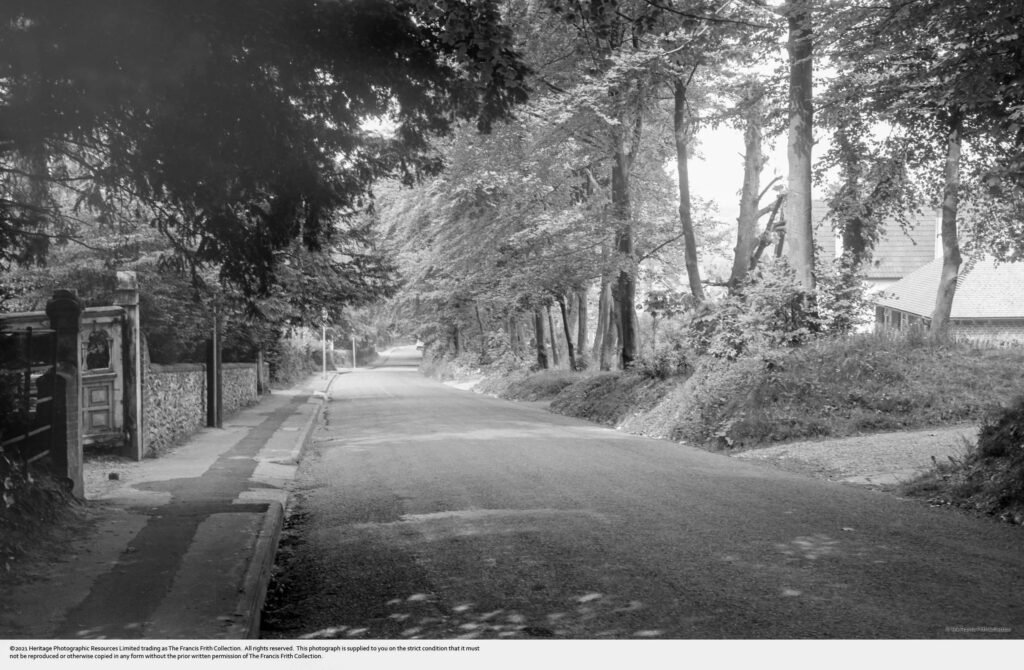
My grandparents bought Twyford in 1952. A family group comprising my mother (Joan Helen Knight) and my father (Eric Arthur Knight) plus me, and my mother’s brother (Professor John Wade Bowen Bray) took up residence as well. There was the option to buy Twyford Lodge, which my mother wanted to do but was dissuaded by my grandfather. I do not remember a lot from those early days except that the whole family worked on restoring the house, fitting a new coke-fired boiler and renovating the rudimentary Victorian heating system. My mother sewed new curtains for the whole house while the menfolk decorated, plumbed, converted the scullery into a kitchen and tamed the large garden which incorporated a hazel nut grove, a walnut tree, a gooseberry patch and a large rhubarb patch, plus an orchard which my grandfather added to. He tried rearing chickens and geese, but the foxes took the chickens and only the aggressive geese survived. The streetlights were still run by gas which was unusual even then. I visited a friend’s grandmother’s house in the cottages on the way to Upwood Gorse and was amazed to see she still had gas lighting in her house. During this time Twyford Lodge was converted from a stables with rooms above into a proper house, and Blue Cedars was built on the site of Twyford’s tennis court. There is also a meter in the hall with a key which the owner used to control the gas fires in the bedrooms and servant’s quarters!
Following my grandmother’s stroke and eventual death the house deteriorated, and this accelerated after my grandfather’s death. Claire and I eventually bought it from Professor Bray in 1984 when he moved up to Harrogate to be close to his sister, my mother. The surveyor’s report was not good, even by the standards of the day, but it ended by stating it was structurally sound and every pound spent on it would yield a return. This was the beginning of the money pit!
To this day it is easy to visualise the life of the people who lived at Twyford because many of the original features are as they would have been when built in 1895. The impressive hallway still has a sense of elegance that harkens back to a bygone era when Harry and Florence welcomed influential Victorian Caterham guests into their home. Twyford Lodge also sits close by and is now a private home. But there have also been many changes. There are now forty houses in the seven acres of garden that existed in 1910, and today the two gardeners, stable boy, groom, maid and cook have been replaced by a mixture of technology and elbow grease.